
If you’re searching for practical ways to elevate your living space, you’re in the right place. This article is designed to help you navigate the most impactful ideas in residential design highlights, from smart layout strategies and interior styling principles to small upgrades that dramatically improve comfort and function.
Home design inspiration is everywhere—but not all of it is practical, affordable, or suited to real-life living. Here, we focus on solutions that balance beauty with usability, helping you create a home that reflects your personality while supporting your daily routines.
To ensure accuracy and relevance, we draw on insights from experienced interior designers, space planners, and home organization specialists, along with current design research and proven styling techniques. Whether you’re refreshing a single room or rethinking your entire home, this guide will provide clear, actionable ideas you can confidently apply to transform your space.
The Secret Language of a Beautiful Home
Why does one room feel effortlessly cohesive while another, filled with lovely pieces, feels off? It’s a common frustration. Some argue great style is pure instinct—or budget. But that overlooks structure. We’ll demystify design by breaking it into seven universal elements, a practical framework moving from a room’s foundational bones to its finishing layers. Think of it as residential design highlights translated into daily decisions.
• You’ll learn to diagnose layout, light, texture, and balance with intention.
This guide equips you to evaluate your own space and choose what truly works for you.
The Foundation: Mastering Space and Light
Space: The Canvas of Your Home
In interior design, positive space refers to areas filled with furniture or décor, while negative space is the empty room around them. Think of positive space as the actors on a stage and negative space as the breathing room that lets the performance shine. Too much furniture (positive space) makes a room feel cramped. Too little can make it feel unfinished or echoey (yes, that “waiting room” vibe).
Balance creates flow—the natural way your eye and body move through a room. Clear pathways and thoughtful furniture placement are essential residential design highlights that prevent visual clutter.
Actionable Tip for Space:
- Walk your main traffic paths. Are they clear and intuitive?
- Remove one piece of furniture temporarily and notice how the room feels. (You might not put it back.)
Light: The Sculptor of Atmosphere
Lighting works in three layers:
- Ambient lighting: overall illumination (ceiling fixtures).
- Task lighting: focused light for activities (reading lamps).
- Accent lighting: dramatic highlights (wall sconces, spotlights).
Maximize natural light by keeping windows unobstructed.
Actionable Tip for Light: Install a dimmer switch on an overhead fixture. It’s a small upgrade with major mood control—bright for productivity, soft for evenings at home.
Creating Structure: The Power of Line and Form
I once walked into a friend’s living room and felt oddly restless. Nothing was technically wrong—but everything was flat. The long, low sofa, the wide media console, even the art were all horizontal. My eyes had nowhere to climb.
That’s the power of line—the path your eye naturally follows through a space. In design, a line is a visual pathway created by edges, seams, or alignments. Different lines create different feelings:
- Vertical lines suggest height and grandeur (think cathedral windows).
- Horizontal lines evoke stability and rest (like a calm horizon).
- Dynamic lines—diagonal or curved—add energy and movement.
Actionable Tip: Identify the dominant line in your room. If it’s horizontal, add a tall floor lamp or hang curtains higher to introduce contrast. (It’s like giving the room better posture.)
Now let’s talk form, the three-dimensional shape of objects. Geometric forms—squares, rectangles, circles—feel structured and predictable. Organic forms are curvier and more natural, like a leafy plant or a sculpted chair.
If your space is full of boxy furniture, balance it with a round mirror or a plant with irregular leaves. The best residential design highlights mix both—structure and softness working together.
Layering Personality: The Sensory Duo of Color and Texture
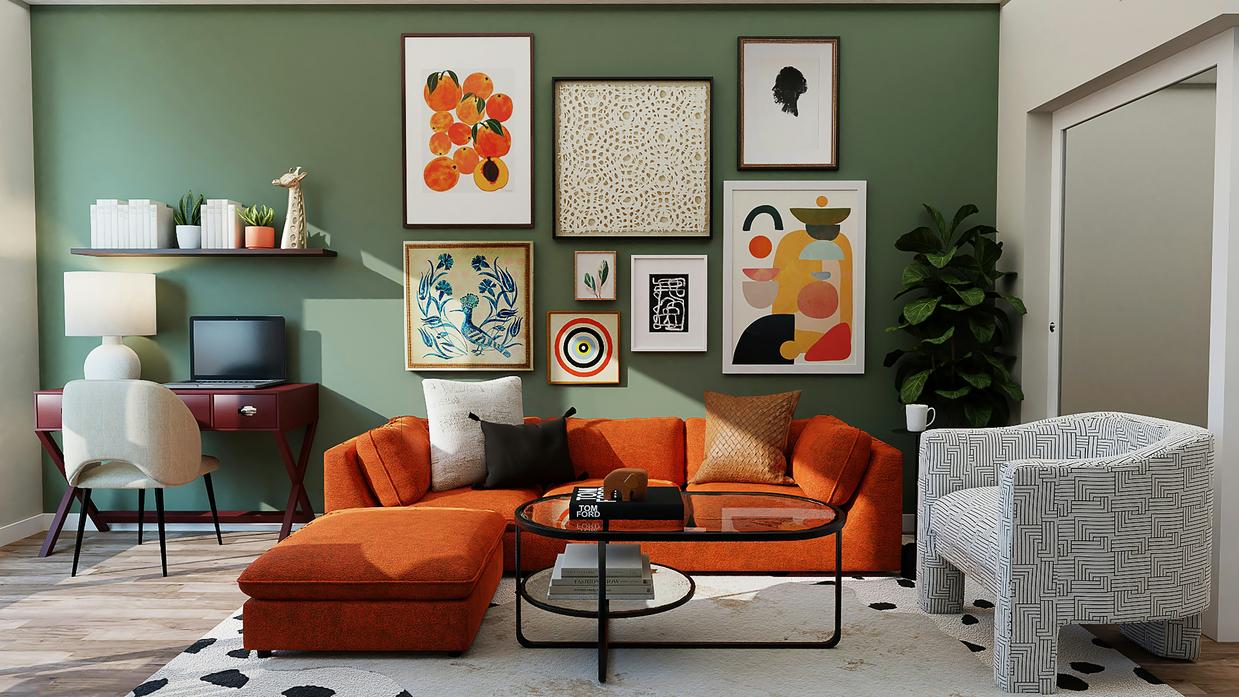
Color: The Heartbeat of the Room
Color shapes how a space feels before you ever sit down. In simple terms, hue is the color itself (blue, green, terracotta). Value refers to how light or dark that color is. Intensity describes how bright or muted it appears. A pale sage wall and a deep forest sofa share the same hue but differ in value and intensity.
To keep color from feeling chaotic, designers often use the 60-30-10 rule. This guideline means 60% of the room features a dominant color (like walls), 30% a secondary shade (upholstery), and 10% an accent (pillows or art). It’s practical, balanced, and surprisingly flexible.
Actionable Tip for Color: Choose a favorite painting or rug and pull three colors from it. Assign each shade a role using the 60-30-10 rule and imagine how it could translate into your walls, furniture, and accessories.
Texture: The Feeling of Home
If color is the heartbeat, texture is the soul. Visual texture is how something looks like it would feel (a photo of woven rattan). Tactile texture is the physical sensation—smooth marble, nubby wool, sleek leather.
Contrast creates comfort. A smooth leather chair paired with a chunky knit throw instantly feels layered and inviting. These combinations are often featured in residential design highlights because they add depth without clutter.
Actionable Tip for Texture: Build a small “texture collection” on your sofa—one soft element (velvet pillow), one rough (linen cushion), and one smooth (leather lumbar). Notice how the mix elevates the entire space.
For deeper insight into evolving aesthetics, explore how to identify emerging home design trends before they go mainstream.
The Final Polish: Using Pattern with Purpose
Pattern is the intentional repetition of a design—think stripes marching across a rug or a floral motif echoing on throw pillows. When used thoughtfully, it adds movement, personality, and depth to a room (because blank walls alone rarely spark joy). More importantly, the right pattern mix can make a space feel layered and professionally styled.
However, scale is everything. To avoid visual chaos, combine large-scale patterns (like oversized florals), medium-scale designs (such as classic plaids), and small-scale prints (like tight geometrics). This contrast creates balance, guiding the eye comfortably around the room.
The golden rule? Vary the scale, but keep the color palette consistent. For example, navy stripes, navy florals, and navy geometrics instantly feel cohesive.
If you’re new to mixing patterns, start with a monochromatic scheme. Different patterns in shades of one color feel intentional, not overwhelming. As seen in residential design highlights, this approach delivers energy without sacrificing harmony.
Your Blueprint for a Thoughtful Home
You now have a complete framework—the seven key elements—to turn any room from accidental into intentional. If design choices have felt overwhelming, start at the foundation. In simple terms, “Space” means how a room is arranged, and “Light” refers to natural and artificial illumination. First, clarify layout; then, improve brightness. This hierarchy works because structure supports style, preventing mismatched finishes and impulse buys (we’ve all been there). In other words, build before you decorate. Review residential design highlights and choose one room. What change can you make this week to enhance space or light
Bring Your Vision to Life with Confidence
You came here looking for clarity, inspiration, and practical direction for your home — and now you have a clearer path forward. From understanding smart layout choices to refining your residential design highlights, you’re better equipped to create a space that feels intentional, functional, and uniquely yours.
We know how overwhelming it can feel to juggle trends, layouts, storage needs, and personal style all at once. That frustration of not knowing where to start — or worrying you’ll make the wrong design choice — is real. But with the right guidance and inspiration, your home can truly work for your daily life instead of against it.
Now it’s time to take the next step. Explore more expert-backed insights, apply one improvement at a time, and transform your space with confidence. Join thousands of homeowners who trust our top-rated guidance to simplify design decisions and elevate everyday living — start planning your next upgrade today.