
A staircase is more than a functional feature—it can define the entire character of a home. If you’re searching for ideas, inspiration, or practical guidance on grand staircase design, you’re likely looking to create a striking focal point that elevates your interior while maintaining everyday usability. This article is crafted to help you do exactly that.
We’ll explore inspiring design concepts, layout considerations, material choices, and styling techniques that transform a staircase into an architectural statement. Whether you’re renovating, building from scratch, or simply refining your home’s aesthetic, you’ll find actionable insights tailored to both modern and classic spaces.
Our guidance draws from established interior design principles, architectural best practices, and current styling trends to ensure the ideas shared are both beautiful and structurally sound. By the end, you’ll have a clear understanding of how to approach a grand staircase in a way that balances elegance, proportion, and practicality.
A large staircase isn’t merely a way to move between floors; it’s the architectural heartbeat of a home. In my view, too many projects treat it like an afterthought, when it should anchor the entire spatial story. However, creating a true statement means juggling structural loads, safety codes, tread-to-riser ratios (the proportional relationship between step height and depth), and material performance.
For example, floating steel stairs look cinematic—very Gatsby—but demand rigorous engineering and compliant guardrails. Ultimately, thoughtful grand staircase design balances drama with durability. Plan boldly, yet respect physics. Because beauty without safety is simply bad design every single time.
Blueprint for a Masterpiece: Core Staircase Concepts
Defining “Large”: A staircase becomes grand not just by height, but by proportion, width, and how it anchors a room. Scale refers to overall dimensions; architectural integration means the stair feels intentional, not wedged in as an afterthought (we’ve all seen that). So, what’s next after size? Structure.
Straight & L-Shaped: Classic, powerful, and space-defining, these layouts create clear sightlines and natural pauses at landings. Bifurcated (Grand): Two symmetrical flights splitting from a central landing deliver theater-level drama—think old Hollywood entrances. Helical & Spiral: Sculptural curves that conserve floor area while commanding attention. Floating (Cantilevered): Treads anchored into a hidden support system for a minimalist, gravity-defying look.
However, some argue large stairs waste space. Yet when planned within a cohesive grand staircase design, they actually improve circulation—the predictable paths people take through a building. Placement shapes movement patterns, frames views, and signals hierarchy between public and private zones. Next, consider materials, lighting, and code requirements; pro tip: consult local regulations early to avoid costly redesigns. A staircase doesn’t just connect floors—it choreographs experience. Consider handrails, balustrades, and acoustics to ensure comfort matches the visual impact. Plan boldly, but measure twice always carefully.
Crafting Character: Choosing Materials for Impact and Longevity
The Foundation: Concrete & Steel
To begin with, concrete and steel form the backbone of ambitious interiors. Concrete— a composite material made from cement, aggregates, and water—offers exceptional compressive strength, while steel provides tensile strength (its ability to resist pulling forces). Together, they enable wide, column-free spans and bold structural statements. Think of the industrial-chic loft aesthetic popularized in converted warehouses—exposed beams, raw finishes, no apologies. Critics argue concrete feels cold or impersonal. Fair point. Yet when paired with warm lighting or cladding, it becomes a versatile canvas rather than a sterile slab.
Timeless Warmth: Hardwoods
Oak, walnut, and maple each bring distinct grain patterns—the natural lines formed by a tree’s growth rings. Oak is durable and traditional; walnut leans rich and contemporary; maple offers a lighter, minimalist feel. Proper finishing (staining, sealing, or oiling) enhances durability and tone. Some designers claim engineered alternatives outperform solid wood in stability. However, real hardwood ages with character—like a well-loved vinyl record (yes, it sounds better over time).
Modern Transparency: Glass
Structural glass—engineered to bear loads—can be used for treads, balustrades, and even stringers to maximize light. Anti-slip treatments and etched surfaces improve safety. While skeptics question durability, tempered and laminated glass meet rigorous safety standards (International Building Code, 2021).
Natural Elegance: Stone
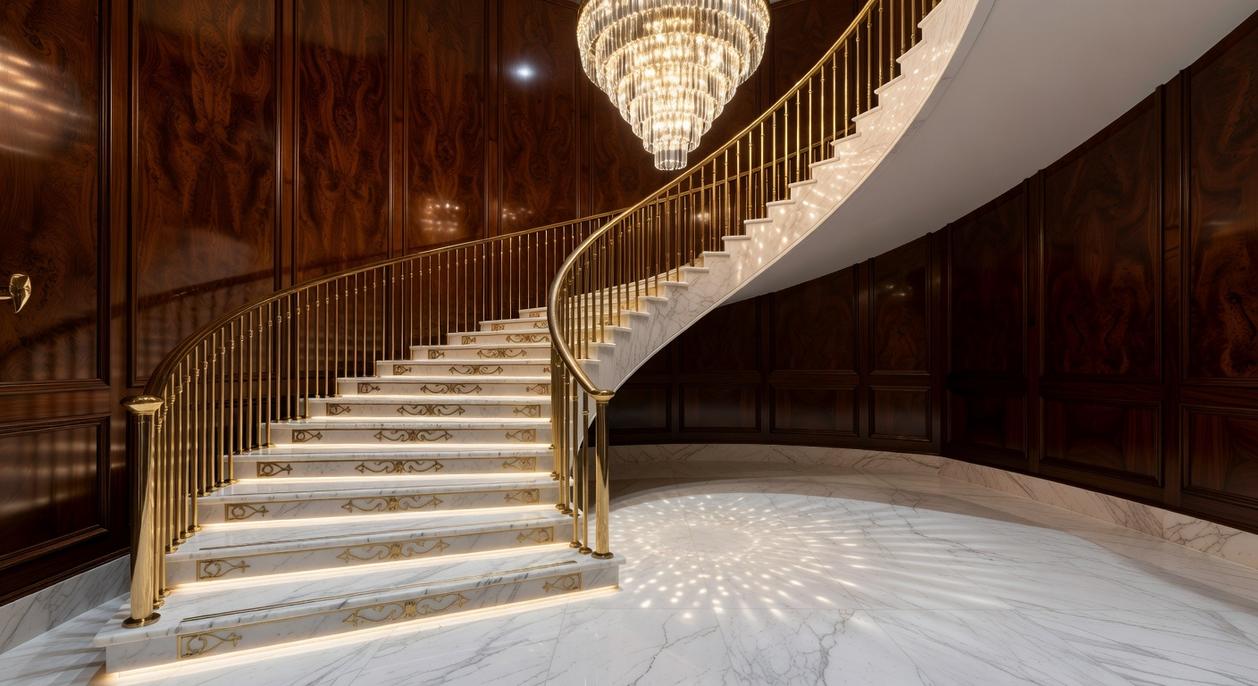
Marble, granite, and limestone signal luxury. Marble veining feels cinematic—very “Succession.” Granite resists scratches; limestone offers softness. Still, stone demands sealing and structural support due to weight.
Combining Materials
Ultimately, pairing steel with wood softens strength, while concrete and glass amplify openness—ideal in grand staircase design or when designing double height living rooms for dramatic impact (https://homenumental.com.co/designing-double-height-living-rooms-for-dramatic-impact/). Pro tip: balance one dominant material with one accent to avoid visual overload.
Safety and Structure: Navigating Building Codes and Dimensions
When it comes to staircases, style is optional. Safety isn’t. Residential projects typically follow the International Residential Code (IRC), while commercial spaces use the stricter International Building Code (IBC)—both set minimum safety standards in the U.S. (ICC, 2021). In other words, your aesthetic vision must fit inside a legal framework.
Key Measurements Explained
Riser Height vs. Tread Depth. The “7–11 rule” means a riser (the vertical step face) is about 7 inches high and the tread (the horizontal surface you step on) about 11 inches deep. IRC limits risers to 7.75 inches and requires consistency within 3/8 inch. A dramatic staircase with uneven steps may look cinematic (hello, period dramas), but inconsistency is a top cause of trips.
Width: Residential vs. Commercial. Residential stairs may be 36 inches wide minimum, whereas commercial stairs often require 44 inches or more (IBC). A grand staircase design exceeds these baselines, prioritizing flow and presence rather than mere compliance.
Headroom Clearance. Both IRC and IBC require at least 6 feet 8 inches of vertical clearance. Anything less invites bumped heads (and liability).
Balustrades and Handrails
Handrails must be graspable (1.25–2 inches in diameter), typically 34–38 inches high. Meanwhile, the “4-inch sphere rule” prevents baluster gaps wide enough for a child’s head to pass through. Pro tip: always verify local amendments before finalizing plans.
The Art of the Staircase: Lighting, Landings, and Integrated Design
A staircase should do more than connect floors—it should elevate the entire room (literally and visually).
Strategic Illumination
Good lighting balances beauty and safety. Consider:
- Pendant chandeliers in open voids to create vertical drama.
- Integrated LED strips under treads or along handrails for subtle, modern glow (and fewer missed steps at night).
- Wall sconces spaced evenly to reduce shadows and eye strain.
Layering these sources prevents harsh contrasts and highlights architectural details.
The Purpose of Landings
Landings aren’t just pauses in direction. They’re functional moments. Add a slim bench, a reading chair, or a bold artwork to turn a transition into a destination.
Under-Stair Potential
Don’t waste this footprint. Think built-in shelving, a compact powder room, or even a climate-controlled wine nook.
Making It a Focal Point
Contrast railing materials, install a continuous runner, or experiment with balustrade patterns to anchor your grand staircase design within the broader interior scheme.
Your Staircase, Your Statement
A successful large staircase stands on three pillars: structural form (the engineering skeleton), material choice (wood, steel, stone—the personality), and code compliance (the safety rules that keep everyone upright). In my view, grand staircase design only feels intimidating until you separate those parts. Break the monster into modules and it becomes manageable. Some argue you should leave it entirely to professionals. I disagree. When you understand the basics, conversations shift from confusion to collaboration. This is your design moment. Treat the staircase not as a hurdle, but as the boldest opportunity in your space. Own it.
As grand staircases gracefully ascend through opulent entryways, they not only serve as stunning architectural features but also offer an ideal opportunity to enhance the overall design narrative of your home, making it essential to explore our Step-by-Step Guide to Creating a Cohesive Room Aesthetic for tips on harmonizing styles throughout your space.
Elevate Your Home with a Statement Staircase
You set out to discover how the right staircase can transform your home’s look and feel—and now you can clearly see the impact a thoughtfully planned grand staircase design can make. From enhancing visual flow to creating a striking focal point, the right design doesn’t just connect floors; it elevates your entire living experience.
If you’ve been struggling with a space that feels ordinary, cramped, or lacking character, this is your opportunity to change that. A well-executed staircase can solve those design frustrations by adding elegance, openness, and architectural interest that instantly upgrades your home.
Don’t let your entryway or central living space fall flat. Explore inspiring ideas, refine your vision, and take the next step toward a home that truly reflects your style. Discover how to bring your grand staircase design to life today—and turn your everyday surroundings into something remarkable.